


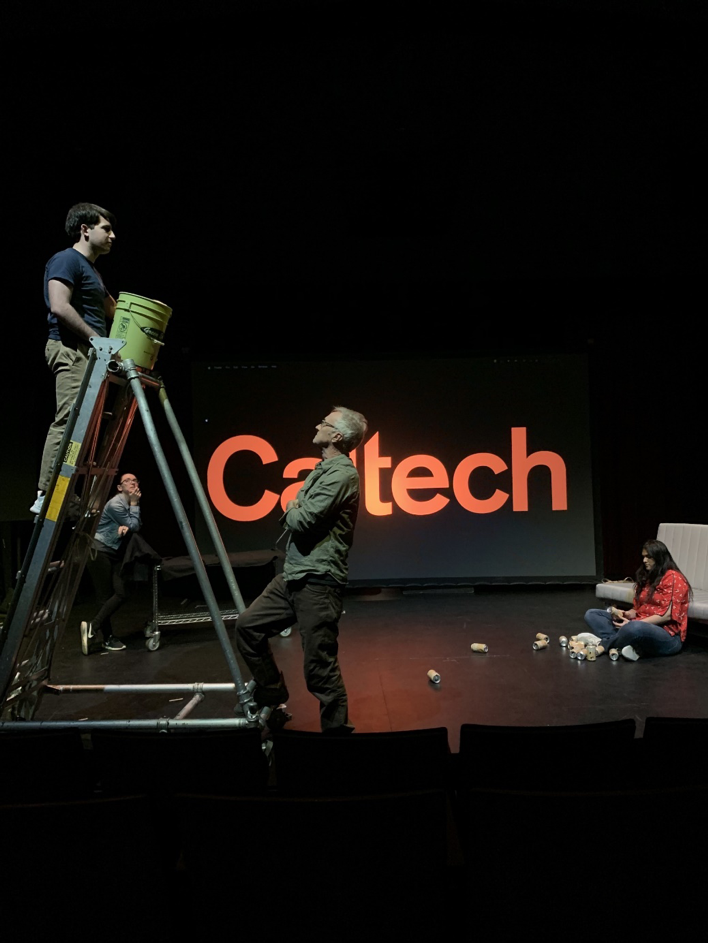
At the California Institute of Technology (Caltech), scientists are charting cosmic phenomena, unlocking the mysteries of the brain, and advancing quantum science. Brian Brophy is orchestrating a different kind of discovery. As director of Theater Arts at Caltech (TACIT) – a program designed to give researchers a creative outlet – Brophy and his team are sparking new conversations around the value of science in society.
Launched in the 1980s by director Shirley Marneus, TACIT was originally intended to be a space for researchers to engage in all aspects of theatrical production, from acting and stagecraft to costume and set design. Since taking the helm in 2008, Brophy has transformed it into something more: a space where researchers wrestle with fundamental questions – What are you doing? Why should we care? What impact can you see? – through the power of performance.
By weaving performance into the fabric of scientific inquiry, Brophy is ensuring that the greatest discoveries are not just made, but deeply felt.
The power of storytelling
Brophy’s belief in the transformative power of storytelling was cemented long before he came to Caltech, during a pivotal moment in his career. A Fulbright scholarship took him to India, where he immersed himself in emancipatory theatre, a form of storytelling that empowers individuals and communities to address societal challenges and foster social change.
Great stories leave the audience asking, “What do we do now? What can we do?”
“The Fulbright really changed things for me,” Brophy recalls. By then, he had already built a successful acting career, appearing in films such as The Shawshank Redemption, Armageddon, and The Player. But something was missing. India gave him a deeper purpose, introducing him to peacebuilding theatre projects that used performance to amplify marginalized voices and foster dialogue.

“It allowed me to dig into what I was most interested in: individual agency and collective gatherings that help to transform situations,” says Brophy. This experience solidified his conviction that theatre could be more than entertainment – it could be an instrument for change.
Disrupting the status quo
Bringing this ethos to Caltech, Brophy was ready to push boundaries. His debut production, Bertolt Brecht’s Galileo, set the tone. A play written in exile during Nazi Germany’s rise, Galileo critiques power structures that suppress truth – a theme as relevant today as it was in the 1930s.
The choice was bold. Scientists and students, accustomed to more traditional productions, were hesitant at first. But Brophy believed in theatre’s ability to challenge assumptions, and from there he struck a balance, staging classics such as Much Ado About Nothing and Rent alongside original works like Pasadena Babalon, which explored Caltech’s history and its intersections with mysticism, magic, and rocketry.
Theatre is not about finding answers – it’s about prompting audiences to think differently about the world.
For Brophy, theatre is not about finding answers – it’s about prompting audiences to think differently about the world. Earth Data: The Musical, his 2024 collaboration with Kimberley Rain Miner and Bradley Gay, two climate scientists from NASA’s Jet Propulsion Laboratory exemplified this. Translating complex climate research into an engaging narrative, the production culminated in a fictional congressional hearing, leaving the audience to grapple with unresolved questions about accountability and climate action.
“We are not solving the climate crisis,” Brophy says. “But it’s a provocation that demands an answer.”
A tool for scientists
Beyond performance, Brophy’s work at TACIT is helping scientists to confront a hidden struggle: imposter syndrome. By incorporating movement and storytelling into their work, researchers can trigger new ways of perceiving the value of their work, he says. “When scientists tap into these elements, they can approach their work with greater confidence,” says Brophy. “The body becomes involved with the brain. They begin to move differently, approach their work differently.”
We are not solving the climate crisis, but it’s a provocation that demands an answer.
In blending theatre with science, Brophy fosters a rare dialogue – one that transcends disciplines and disrupts hierarchies. His productions aren’t simply there to entertain; they’re designed to provoke and inspire. As the world faces urgent crises, from climate change to ethical dilemmas in AI, Brophy’s work underscores the need for collaboration between art and science.
Great theatre, Brophy argues, doesn’t just elicit emotion: it compels action. “Great stories leave the audience asking, ‘What do we do now? What can we do?’”
Follow Brian Brophy on LinkedIn.
Story by Sam Illingworth.