


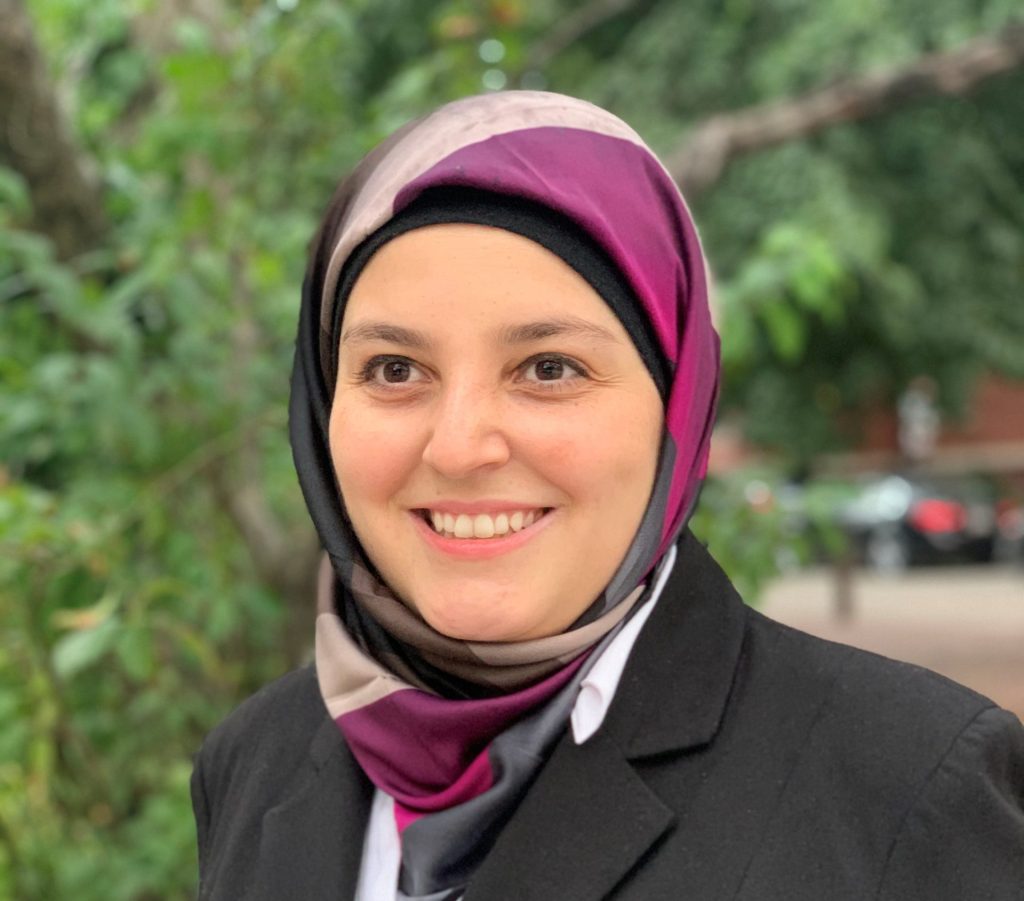
Among her long list of achievements, Mona Minkara holds the unofficial record for the most time in zero gravity for a blind scientist. It started in 2021, with her first flight into zero gravity aboard a modified Boeing 727 – nicknamed the ‘Vomit Comet’ – for parabolic flights to simulate the weightlessness of space for short periods of time.
“I was so excited,” she says of her first flight. Martian gravity – which equates to about one-third of Earth’s gravity – came first. Then, the gravity was reduced to simulate lunar gravity – about one-sixth of Earth’s gravity – followed by zero gravity.
As we went into the zero-gravity flight, I was laying down on the floor and I had my hands across my chest, mummy style, to contain my excitement.
“They eased us into it a little bit,” Minkara recalls. “With the Martian gravity, I jumped up [and] hit the ceiling so hard that I bounced back to the floor. I was like, ‘I have to calm down!’ I had to give myself a lecture. So, as we went into the zero-gravity flight, I was laying down on the floor and I had my hands across my chest, mummy style, to contain my excitement.”

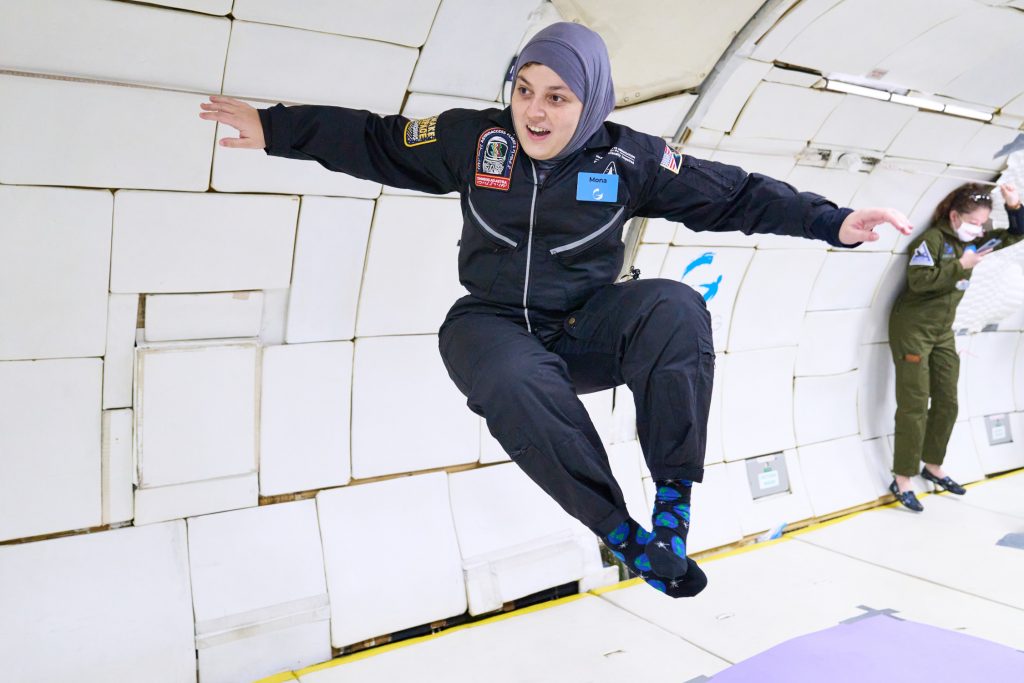
The experience was part of AstroAccess, a programme that enables disabled scientists, students, athletes, veterans and artists to participate in microgravity research and astronaut training. Minkara, who is blind, conducted observations and experiments during the flight, which she hopes will inform the future design of space craft to be more inclusive.
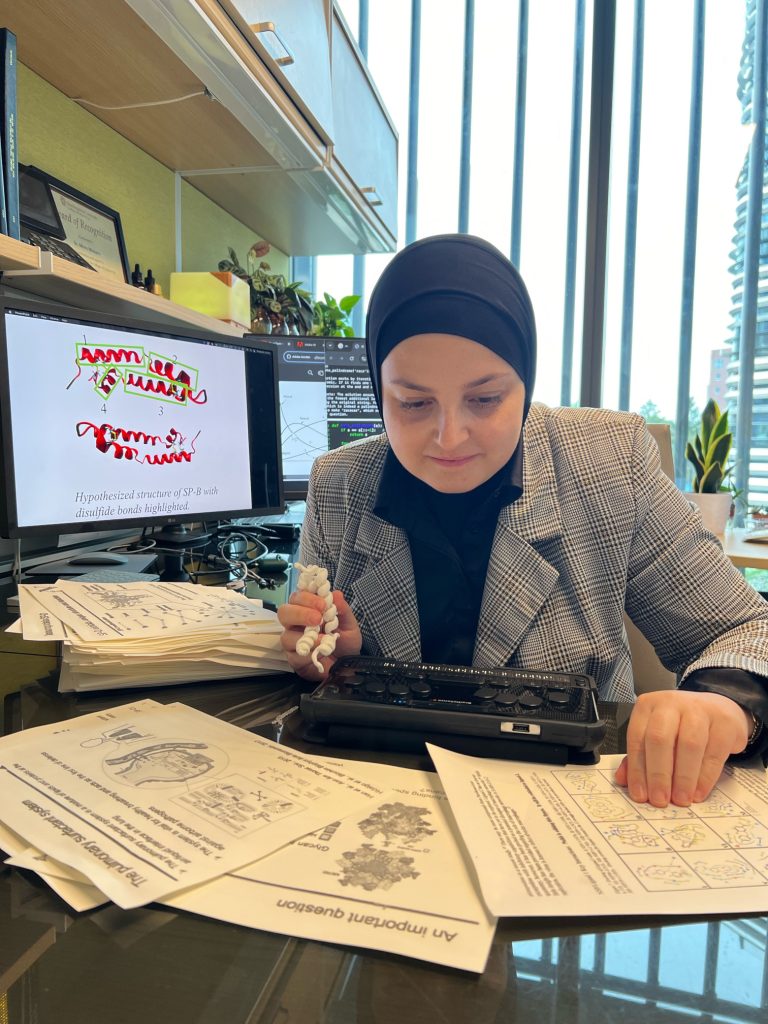
It’s just one aspect of the work Minkara is doing to advocate for people with disabilities in STEM. Beyond her research at the COMBINE laboratory at Northeastern University in Boston (where she uses computational modelling to understand at the molecular level biological interfaces, such as those found in the lungs) Minkara has helped to develop the Blind STEM Curriculum – a collection of experiment-based lesson plans for blind and visually impaired students.
My emphasis was to show how diverse these people are that you really don’t even realise, from people who have disabilities to those from all parts of the world.
Participating in everything she can – whether it’s rock-climbing, zip-lining or martial arts – Minkara wants to show how being blind is not the roadblock it is often made out to be. On her YouTube channel, she documents experiences such as navigating JFK Airport and trekking to Machu Picchu, in Peru.
She also produces a series of short videos called Scientist of the Week, which focus on scientists who have had major impacts, but are not just “white dudes”, as she puts it. “My emphasis was to show how diverse these people are that you really don’t even realise, from people who have disabilities to those from all parts of the world.”
A different perspective
Diagnosed with macular degeneration and cone-rod dystrophy at the age of seven, Minkara’s blindness progressed rapidly. But she struggled to understand why other people seemed so devastated about her condition. “Part of me was kind of upset,” she says. “Nothing changed in my soul, like, who I was as a person. But it seems like everybody’s expectations of me changed.”
Minkara had developed a love of science by watching The Magic School Bus on TV, but when she talked about becoming a scientist, she was repeatedly told that it wasn’t practical. “A doctor told my parents that it wasn’t worth spending a penny on my education,” she recalls. “But it didn’t change my love for science.”
Part of me was kind of upset…Nothing changed in my soul, like, who I was as a person. But it seems like everybody’s expectations of me changed.
With no real plan for where she wanted to end up, Minkara completed her Bachelor of Arts, majoring in chemistry and Middle Eastern studies at Wellesley College in Massachusetts. “I just took a bunch of random classes, all based on what I like to do,” she says. “Then, I sat down and looked, and I had taken [mostly] chemistry courses. So, I was like, ‘I’ll be a chemist.’”
She pursued a PhD in computational physical chemistry at the University of Florida, where she investigated treatments that could stop Helicobacter pylori – a harmful bacterium that weakens the stomach lining and causes ulcers – from surviving in the stomach by targeting a key enzyme it uses for protection.
Fast-forward to today, and Minkara is investigating how different components of pulmonary surfactant can help boost our immune system and help us fight more effectively against pathogens. Last year, she received a five-year US$827,000 National Science Foundation award for this work, and a $1.95 million US National Institutes of Health MIRA R35 award for developing new strategies to combat bacterial infection.

Minkara attributes some of this success to her postdoctoral advisor Dr J. Ilja Siepmann, at the University of Minnesota, who told her that her blindness was an asset, because she could solve problems in ways that others hadn’t thought of.
“I can’t observe science in the same way as other people, right? I can’t see what I need to see, so I have to come up with other ways of getting to my goal,” says Minkara. “Sometimes that allows me – as somebody who is different – to obtain knowledge that nobody else has obtained, just because I had to do it differently.”
She gives an example of when she was studying a particular protein, as a graduate student, and couldn’t watch a simulated model of how it moves over time. “I came up with a way of mathematically graphing what was relevant to me, and because of that, I actually found patterns that my sighted colleagues had missed,” says Minkara. “I was able to understand the function and how this protein moved more effectively, because I couldn’t do it the same way as everybody else.”
Improving access
Since earning her PhD, Minkara has developed programmes and curricula with Baylor University in Texas that allow blind and visually impaired students to run experiments in chemistry and other areas of science, using everyday household objects.
“It [includes] experiments like, ‘build your own record player’ or ‘make your own stethoscope’, or ‘grow a radish,’ she says. “Even in high school, a blind kid wouldn’t get access to doing chemistry in the lab. They would never have the chance to know if they like it or not.”
Feedback from the students includes those who now say, ‘I want to be a scientist’, says Minkara.
Minkara says she is struggling in some ways to deal with the anti-science agenda in United States and elsewhere. “The consequences are actually real people are dying,” she says.
Her strategy when engaging with people with a poor understanding of science is to try to be patient. This is where the power of storytelling comes in, to convey the truth of science, says Minkara. “There’s a power to knowing how to share the science … and sharing it so that the audience can digest it.”
I needed to let go of ‘sounding smart’. I think what’s really more important is to share the knowledge, to share the story.
She says researchers aren’t even good at communicating science to other researchers, let alone the wider community, and challenges the research community to find ways to make their work more accessible. “You go to a conference and they speak at such a high level that even their colleagues are like, ‘What is it that you’re talking about?’ How is this helpful to anybody?” says Minkara.
She recalls when she was asked to speak at the 2021 American Chemical Society conference in Atlanta. She faced a dilemma: do I want to sound smart, or do I want to tell a good story? “I remember deciding, ‘No, I want to tell a good story’,” says Minkara. “I needed to let go of ‘sounding smart’. I think what’s really more important is to share the knowledge, to share the story.”
Story by Ken Eastwood